
Finding Purpose
18 years
It took me 18 years to set off on my journey to Moscow, Russia. It was an adventure I did not even know I would be taking a year prior. I did not pursue college because I had no idea what subject I would study, nor was I confident enough to think that I would succeed at college. I believed that the Adventures in Missions program, AIM, would be an easier transition into adulthood. I was certainly wrong; it proved to be a deep dive into adulthood. I immediately faced the things I said I wanted to postpone as long as possible (budgeting bills, living alone, studying subjects that changed the course of my life, coming face to face with who I was and teaching others), only with a few curve balls: learning a new language and developing a family group with total strangers. I had no idea what I was truly getting into in this adventure, but I had faith that God had a plan.
After determining that AIM was a more acceptable fit for my life pursuits, I quickly applied and started petitioning for financial support for 8 months of Bible study in Lubbock, TX and 2 years on a mission field. While I was reaching out to sponsors, I expressed that I had no preference where I served, but I would just rather not serve in Russia. So you can imagine the questions I received upon follow-up meetings regarding my mission field! My judgment of Russia was based on a combination of the Cold War history between America and Russia, the language (I already knew learning languages was not my strong point), and the news of terrorist acts in Russia that were appearing in American news sources in the late 1990s. I was very aware of the reports because my cousin Nancy was serving in Moscow two years before me, and my grandparents had 101 reasons why that was not the ideal location for a young student.
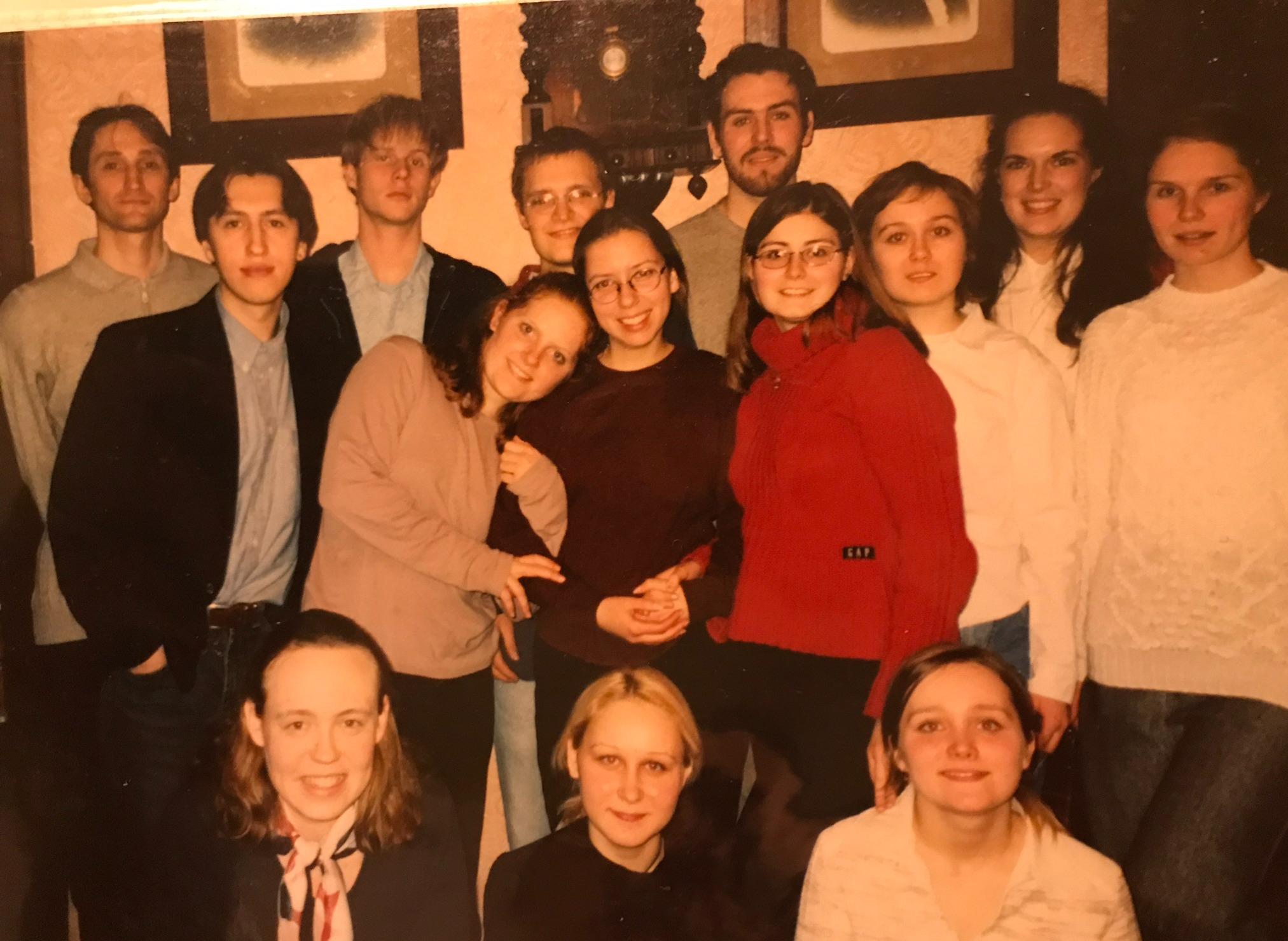
After being placed on the Russian team, we began meeting. The team included individuals who all chose Russia for many reasons, but one common reason for all the others, was the literary brilliance of authors such as Pushkin, Tolstoy, and Dostoyevsky, to name a few. I remember that one of our team meetings became a theoretical discussion over my self-label of nerd and not geek, with the conclusion being that I fit in their group of “intelligentsia” for over-analyzing situations and concepts. We all would continue to over-analyze our work while there. You can imagine that we often became our own biggest obstacles.
Maybe this is the reason that it took me another 18 years to open my journals from Russia. My mind focused on the negative feelings, events, and relationships trying to find solutions. I was afraid that if I read my journals, I would only see my selfish nature and feared that I only wrote when I wanted to complain or let off steam. After all this time, I still had no closure from my time in Moscow. My return home was lonely at best. My church had split while I was gone, and I felt like I had to pick sides. I had no support group to lean into upon reentry. It took a few months for me to find a church, and when I did, there were quarrels among the members. I have felt like a wanderer ever since. Thankfully, what I found in my journals were relationships: Andrea and me experiencing a ballet at the Kremlin from tickets she was given, Natasha taking me to see ice sculptures on my birthday, touring historic sites with my language teacher and her daughter, participating in group activities with the church family at summer camp. These relationships and examples of community allowed me to accept my time overseas as prosperous and educational.
After reconnection with friends from Russia and teammates, I realize that they too reflect (or analyze) on our purpose and our time together. Missionaries often base their success on the number of baptisms they influenced or how many Bibles they have distributed, because, let’s face it, we all want hard evidence that we succeeded. I, too, am goal-oriented and have found much joy in completing a grant project or program at the Museum, but our Kingdom job is not as clear-cut. I don’t know how my life impacted others and cannot always see how others’ lives have impacted mine. I did not write newsletters enough while on the mission field, and I certainly feel like I could have worked harder in Moscow, but our greatest commandments are to 1. Love God and 2. Love your neighbor as yourself, Matthew 22:37-39. We can never know how truly successful we are in God’s book. All we can do is continue to walk in love and truth to share the freedom in Christ that we know. The foundation of this is relationship with God and with others.


Leave a Reply